
SEO gets your content ranked in search results. GEO gets your content cited inside AI-generated answers. In 2026, serious content sites need both, because more and more queries are being answered by AI engines (ChatGPT Search, Perplexity, Gemini, Google AI Overviews) before the user ever clicks a traditional search result.
This post breaks down what each discipline is, how they work under the hood, where they overlap (more than you’d think), and how to divide your time between them.
The 30-second version
- SEO (search engine optimization) gets your pages ranked higher in traditional search engines (Google, Bing)
- GEO (generative engine optimization) gets your content cited by AI engines in their generated answers
- The fundamentals overlap heavily. Strong SEO is roughly 80% of the foundation for strong GEO
- GEO adds specific layers on top: answer-first writing, clear factual claims, structured data, and content AI engines can extract cleanly
- Measure SEO by rankings, impressions, clicks. Measure GEO by citation frequency across AI engines
What SEO is
Search engine optimization is the practice of making a website rank as high as possible in search engines for queries its audience actually searches. The mechanics haven’t changed much in a decade, but the bar keeps rising.
Core SEO work:
- Keyword research and keyword clustering
- On-page optimization (titles, meta descriptions, headers, slugs)
- Technical SEO (Core Web Vitals, indexation, schema, sitemaps)
- Earning backlinks from authoritative sites
- Internal linking and topical authority
- Continuous content refreshes and audits (see the workflow)
Success looks like ranking on page 1 for commercial-intent queries and consistently growing organic traffic. The feedback loop is fast: a well-optimized page can rank within weeks and you can see the impact directly in Google Search Console.
What GEO is
Generative engine optimization is the practice of making your content more likely to be cited inside AI-generated answers. When someone asks ChatGPT Search “what’s the fastest WordPress theme in 2026,” the AI retrieves candidate sources, weighs them, and quotes or paraphrases from the best ones. GEO is about being one of those sources.
Core GEO work:
- Answer the target query directly in the first 100 words of the post
- Use clear heading-to-answer pairing (an H2 question followed by a tight 2-3 sentence answer)
- Include factual claims that stand alone and can be extracted without surrounding context
- Cite authoritative sources yourself (LLMs reward pages that cite sources)
- Maintain clean schema markup and structured data
- Ensure AI crawlers (GPTBot, Google-Extended, ClaudeBot, PerplexityBot) can access your site
- Strong title-to-fanout-query alignment (see how to get cited by LLMs)
Success looks like your brand name appearing in AI answers to your target queries, and referral traffic from AI platforms appearing in your analytics.
How GEO actually works under the hood

AI engines don’t “rank” pages the way Google does. They retrieve, evaluate, and synthesize.
The pipeline looks like this:
- User query: someone asks the AI engine a question
- AI retrieval: the engine expands the query into multiple related “fanout” queries and retrieves candidate web pages that match
- Candidate evaluation: the engine ranks the retrieved pages by relevance, authority, recency, and how cleanly they answer each fanout query
- Synthesis and citation: the engine generates a single answer combining information from the top candidates, citing each source inline
Two things follow from this:
First, traditional ranking still matters a lot. Pages that rank well on Google are statistically overrepresented in ChatGPT Search and Perplexity citations because they’re usually higher up in the retrieval pool. GEO is layered on top of SEO, not instead of it.
Second, the content structure that makes a page easily citable is not automatic. A brilliant long-form essay can rank #1 on Google and still lose the citation to a more structured, answer-first post at #4. GEO’s job is to make sure your content is readable by the synthesis step, not just the retrieval step.
The AI engines landscape
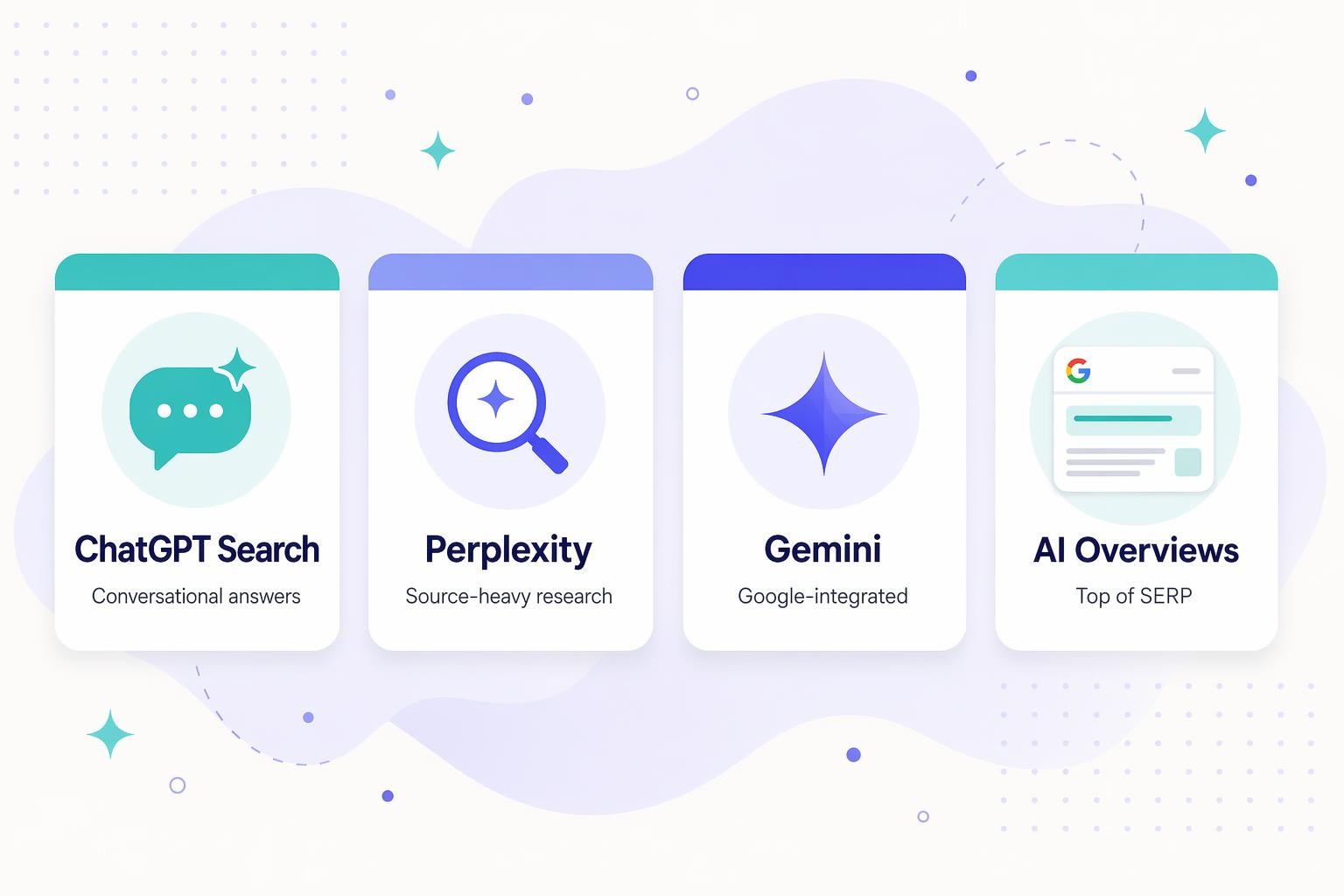
The four engines that matter for most businesses in 2026:
- ChatGPT Search: OpenAI’s native search, used inside ChatGPT. Conversational tone, heavy on recent sources, runs over 800M weekly active users as of early 2026
- Perplexity: the most source-heavy AI answer engine. Citations are visible and clickable. The most important engine for GEO because citation frequency is transparent and measurable
- Gemini: Google’s multimodal AI, integrated into Gemini app, Google Workspace, and Android. Heavily favors Google-indexed content
- Google AI Overviews: the AI-generated summary that appears above traditional search results for many queries. Appears for 60%+ of informational queries in 2026
Each has different signal weights, but the fundamentals of getting cited are similar: be findable (retrieval), be authoritative (evaluation), and be extractable (synthesis).
Where SEO and GEO overlap
Most of SEO is also GEO. The shared foundation:
- Strong topical authority on the target subject
- Fast-loading, crawlable, indexable pages
- Clear content structure with proper heading hierarchy
- Schema markup (Article, BlogPosting, Organization, sameAs)
- Inbound backlinks from authoritative, relevant sources
- Accurate, well-sourced factual claims
- Thoughtful internal link architecture
If you’re new to both, focus on SEO first. You can’t win GEO without the underlying infrastructure that SEO provides.
Where they differ
The layers GEO adds on top of SEO:
- Answer-first writing: the first 100 words must directly answer the target query, not tee it up
- Title-to-query alignment: titles must closely match the fanout queries users ask AI engines (not just the keywords they search Google for)
- Extractable factual claims: sentences should stand alone out of context (“GeneratePress loads in under 1 second on mobile” is extractable; “It loads fast” is not)
- AI crawler access: robots.txt must allow GPTBot, Google-Extended, ClaudeBot, and PerplexityBot if you want to be discoverable by those engines
- Citation-worthy structure: lists, tables, and clear bullet-points are disproportionately cited by AI engines vs. prose
How to measure GEO success
Harder than SEO, but possible. The available approaches:
- Manual citation tracking: ask your top target queries to ChatGPT, Perplexity, and Gemini each month. Note whether your content is cited. Simple, free, time-consuming
- Citation tracking tools: Profound, Otterly.ai, Peec AI, and a growing number of SaaS tools track AI citations at scale across major engines
- Referral analytics: Google Analytics now reports AI engine referrals (chatgpt.com, perplexity.ai, etc.). Referral traffic growth is a proxy for citation growth
- Brand mentions in AI answers: track how often your company, product, or author name appears in AI answers to relevant category queries
Which to prioritize
If you’re starting from scratch:
- Months 1-6: focus on SEO fundamentals (content, keyword research, clean technical setup)
- Months 6-12: add GEO layers on your strongest SEO pages (answer-first rewrites, schema, AI crawler access)
- Ongoing: track citations monthly, iterate on pages that aren’t getting cited
If you already have strong SEO:
- Audit your top 20 ranking pages for GEO readiness
- Rewrite intros to be answer-first
- Add structured factual claims, lists, and tables where they fit
- Start citation tracking
Most of the GEO-specific lift on a mature site is formatting work, not new content. For more on the formatting side, see how to format a blog post for 2026.
SEO vs GEO at a glance
| SEO | GEO | |
|---|---|---|
| Goal | Rank in search results | Be cited in AI answers |
| Main platforms | Google, Bing | ChatGPT, Perplexity, Gemini, AI Overviews |
| Traffic type | Clicks from SERPs | Mentions in AI answers, AI referral traffic |
| Optimization focus | Keywords, backlinks, Core Web Vitals | Answer structure, citations, schema, AI crawler access |
| Success metric | Rankings, CTR, sessions | Citation frequency, AI referral traffic, brand mentions |
| Feedback loop | Weeks (Search Console) | Weeks to months (citation tracking tools) |
| How much to do | ~70% of SEO effort | ~30% of SEO effort (on top of strong SEO) |
The short version
SEO gets you ranked. GEO gets you cited. They share 80% of their foundation, so good SEO is most of the way to good GEO. The differences are in structure: answer-first writing, extractable factual claims, clean schema, and AI crawler access. Start with SEO, layer GEO on top, track both. For a deeper dive on earning citations specifically, see my guide on how to get cited by LLMs. For the broader topic, RightBlogger’s generative engine optimization guide goes deeper on tools and tactics.

Leave a Reply