
Keyword clustering is the practice of grouping related search queries into a single content “bucket” so you can cover a topic comprehensively with one pillar post and several supporting posts, instead of chasing every keyword with its own article.
Done well, it’s the single most efficient content strategy move for a niche site. It builds topical authority, avoids keyword cannibalization, and produces a site structure that both Google and AI engines can actually understand.
This post walks through what clustering is, how to do it step-by-step, a worked example in a real niche (WordPress theme speed), and the tools that actually help.
What keyword clustering actually is
A keyword cluster is a group of queries that share the same underlying user intent but are worded differently. For example:
- “fastest WordPress theme”
- “lightweight WordPress themes”
- “WordPress theme for Core Web Vitals”
- “fastest loading WordPress theme”
These four queries are asking the same thing. Writing four separate posts for them would cannibalize rankings. Grouping them into one cluster and building a single excellent pillar page is how sites rank for all four.
Why clustering matters more in 2026
- Topical authority signals: Google rewards sites that cover a topic comprehensively. Clusters produce that coverage on purpose
- AI citation readiness: LLMs cite pages that answer queries directly. A well-structured cluster surfaces the right page for each fanout query (see how to get cited by LLMs)
- Cannibalization prevention: multiple thin posts targeting similar keywords split your rankings. Clustering consolidates that authority into one post that can actually rank
- Smart content planning: a cluster map is a content roadmap. You know what to write next instead of guessing
- Internal linking flow: clusters make link structure obvious: pillar-to-spoke and spoke-back-to-pillar (see internal linking best practices)
The 5-step keyword clustering workflow
Step 1: Identify your pillar topics
Start with 4-8 broad pillars that define your niche. These are the topics you want to be the go-to resource for.
For SEO Themes, my pillars are:
- WordPress theme SEO
- Technical and on-page SEO
- Modern AI search (GEO)
- Blog content strategy
If your pillars aren’t obvious, audit what your top competitors organize their site around. See how to conduct a content audit for the mechanics.
Step 2: Pull a raw keyword list for each pillar
Cast a wide net. For each pillar, collect 200-500 related keywords using:
- Ahrefs Keywords Explorer or Semrush Keyword Magic
- Google Keyword Planner (free)
- Google Search Console queries (your existing rankings)
- People Also Ask boxes and Google autocomplete
- AnswerThePublic for question-format queries
- ChatGPT or Perplexity for fanout query generation
- Competitor site exports from Ahrefs or Semrush
Don’t filter aggressively at this stage. Get everything, cluster later.
Step 3: Group keywords by intent and semantic similarity
This is the clustering step itself. For each pillar’s raw keyword list:
- Group keywords that mean the same thing (“fastest theme” + “quickest theme” + “fast loading theme”)
- Separate by search intent: informational, commercial, transactional
- Identify subtopics within the pillar (e.g., “theme speed” splits into “testing tools,” “core vitals,” “bloat causes,” “fastest options”)
- Merge tight semantic duplicates into a single cluster
AI clustering tools save hours on this step. Ahrefs, Semrush, and RightBlogger’s Keyword Cluster tool can auto-group semantically similar keywords, though human review is still needed to catch misclassifications.
Step 4: Analyze the SERPs for each cluster
Not every cluster is worth targeting. For a representative keyword from each cluster:
- Check the top 10 ranking pages. Are they long guides, comparison pages, listicles, video embeds?
- Note the AI Overview or SGE snippet if one appears
- Record search volume (Ahrefs/Semrush/GKP) and keyword difficulty
- Spot-check the domain ratings of the top 10: if they’re all DR 80+, you need authority before you rank here
Prioritize clusters with medium volume (500-5,000 searches/month), manageable difficulty (keyword difficulty under 40 for most sites), and genuine business value.
Step 5: Map clusters to content (hub-and-spoke)
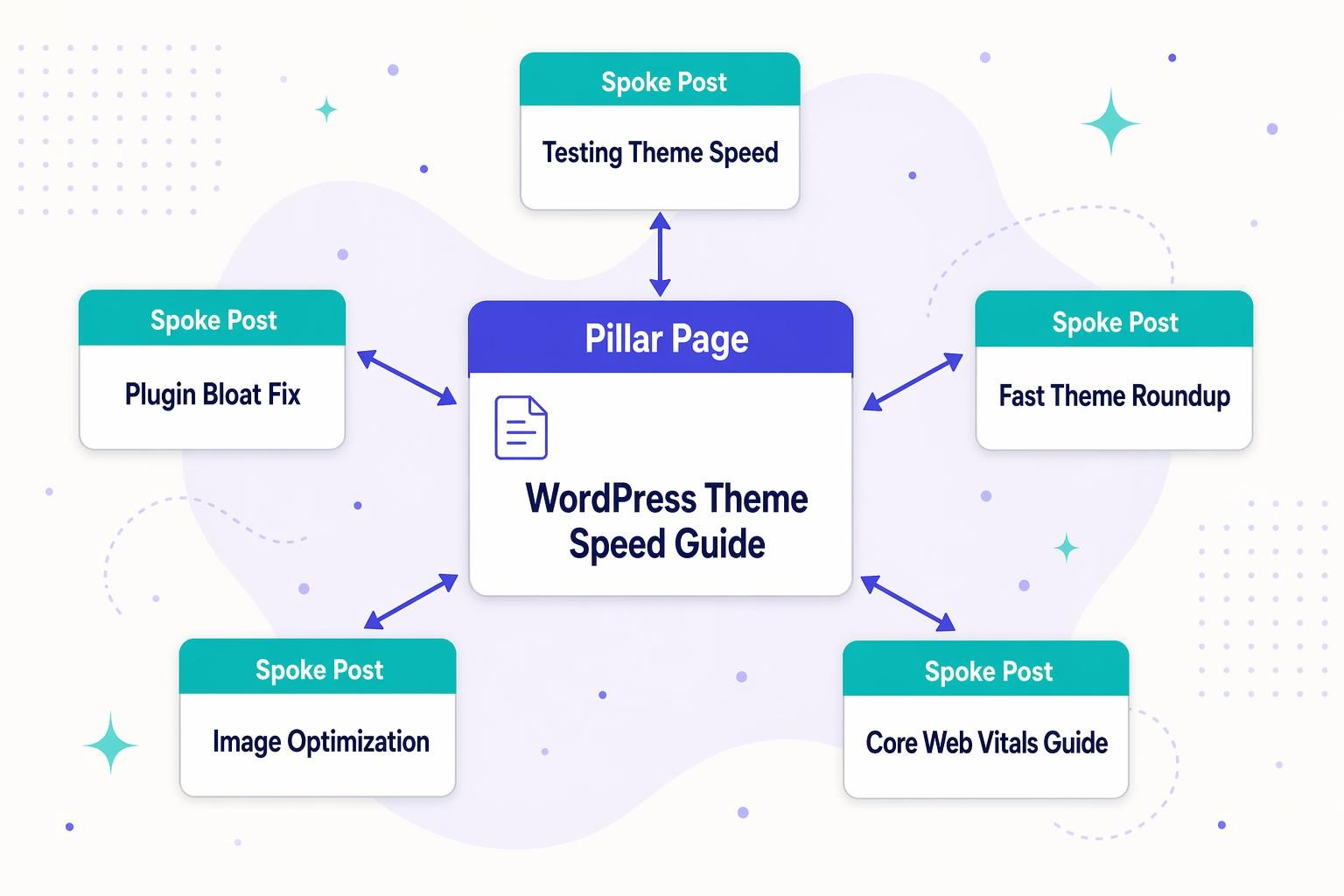
Each prioritized cluster becomes:
- One pillar page targeting the main cluster keyword (comprehensive, long-form)
- Several spoke pages each targeting a specific subtopic or long-tail variant
- Bidirectional internal links: pillar links to every spoke, each spoke links back to the pillar and to relevant sibling spokes
The result is a topical hub that Google, AI engines, and users can all navigate intuitively.
Worked example: the “WordPress theme speed” cluster
Here’s how I’d actually cluster this one pillar.
Pillar keyword: “WordPress theme speed”
Raw keyword list (sample): fastest WordPress theme, lightweight WordPress themes, WordPress theme speed test, why is my WordPress theme slow, Core Web Vitals WordPress theme, GeneratePress vs Astra speed, how to speed up a WordPress theme, PageSpeed Insights WordPress, fastest WordPress theme for Elementor, bloated themes WordPress, WordPress theme benchmark, fastest free WordPress theme, best theme for speed, fastest blog theme, theme speed vs plugin speed…
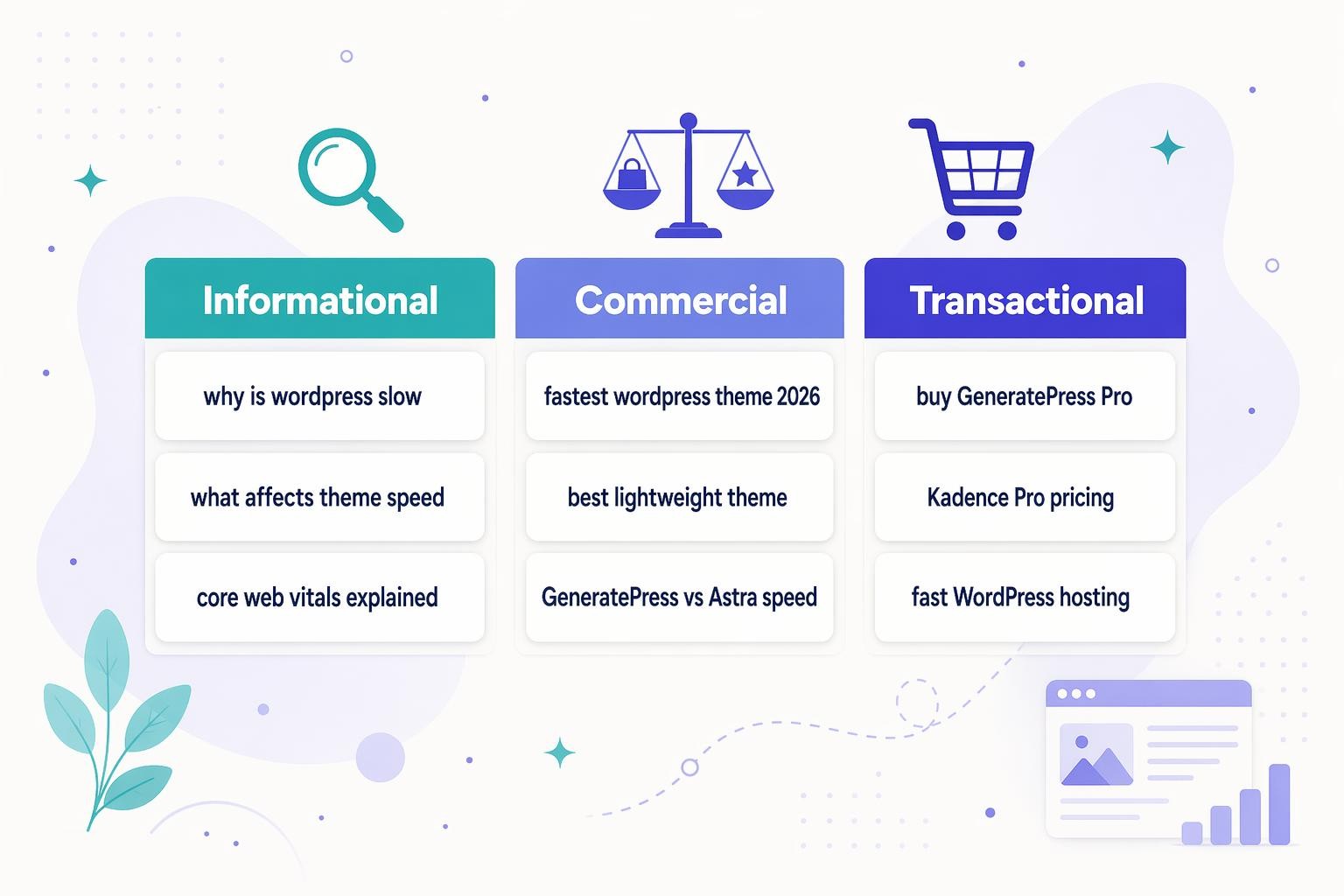
Grouped by intent:
- Informational: “why is my WordPress theme slow,” “what affects theme speed,” “Core Web Vitals explained”
- Commercial: “fastest WordPress theme 2026,” “best lightweight theme,” “GeneratePress vs Astra speed”
- Transactional: “buy GeneratePress Pro,” “Kadence Pro pricing,” “fast WordPress hosting”
Content map:
- Pillar page: “WordPress Theme Speed Guide” (covers what affects it, how to test, what to do)
- Spoke 1: “How to test WordPress theme speed”
- Spoke 2: “Fastest WordPress theme roundup”
- Spoke 3: “Core Web Vitals for WordPress”
- Spoke 4: “Image optimization for WordPress”
- Spoke 5: “Plugin bloat: what to audit and cut”
Notice how the pillar answers the broad “what’s going on” query, while each spoke answers a specific sub-question. The pillar can rank for the broad term; each spoke can rank for its own long-tail query.
Common mistakes
- Creating a separate page for every keyword variation (cannibalization)
- Clustering keywords with different intents into one post (confuses both users and Google)
- Building huge clusters that can’t realistically be covered in one pillar page
- Forgetting internal linking between pillar and spokes
- Skipping the SERP analysis and building clusters Google will never rank you for
- Relying purely on AI clustering without human review for semantic nuance
Tools for clustering workflows
- Ahrefs and Semrush: the gold-standard paid tools, with native clustering and SERP analysis
- Google Keyword Planner + Search Console: free baseline
- RightBlogger Keyword Cluster tool: AI-powered auto-clustering built for bloggers
- ChatGPT or Claude: paste a raw list, ask for intent-grouped clusters (see using ChatGPT for SEO for the right prompts)
- Ryan Robinson’s free keyword tool: ryrob.com/keyword-tool for quick validation
- Spreadsheets: the universal clustering workspace. Google Sheets with filters and pivot tables handles everything the paid tools can if you’re patient
The short version
Keyword clustering groups related search queries so you can build one strong pillar page instead of fighting yourself with several thin ones. Identify your pillars, collect 200+ keywords per pillar, group by intent and semantics, analyze SERPs to prioritize, then map to a hub-and-spoke content structure. Use Ahrefs, Semrush, or an AI clustering tool to speed it up. Get this right once and it becomes the spine of your whole content strategy.

Leave a Reply