
ChatGPT can massively speed up SEO work when used correctly. It can also kill your rankings if you publish what it generates without doing real work on top. The gap between those two outcomes is bigger than most people realize.
This post covers what’s actually changed since 2024, which SEO tasks ChatGPT is genuinely useful for, which ones will get you deindexed, and a real workflow for using it across keyword research, outlining, drafting, and editing.
What changed between 2024 and 2026
In early 2024, “use ChatGPT for SEO content” was a viable growth hack. By mid-2026, several things killed that approach:
- Google’s March 2024 Core Update and follow-on updates demoted or deindexed roughly 40% of the content from sites producing scaled AI-generated content. Google’s own announcement explicitly called out scaled content abuse
- Helpful Content signals now weight first-person expertise, original data, and real reporting. These are exactly the things raw ChatGPT output lacks
- AI engines like ChatGPT Search, Perplexity, and Gemini now cite pages directly, which reshaped what “winning” content looks like (see SEO vs GEO)
- First-party content signals carry more weight now, which further hurt commodity AI content without original perspective
The short version: pure ChatGPT-generated SEO content stopped working. Well-edited AI-assisted content is stronger than ever.
What ChatGPT is actually good at for SEO
Tasks where LLM assistance is a clear win:
- Keyword clustering and topic mapping (grouping 500 keywords into related clusters in minutes)
- Outline generation after you’ve done a SERP analysis
- Drafting first passes you’ll heavily edit
- Rewriting awkward passages into clearer language
- Generating 20+ title and meta description variations to pick from
- Summarizing long research so you can reference it faster
- Translating SEO best practices into first drafts for your specific niche
- Analyzing competitor content structure
- Spotting on-page SEO issues (missing headers, keyword stuffing, broken hierarchy)
What ChatGPT is actively bad at
And will get you penalized if you rely on it:
- Writing with actual experience or first-hand insight (it has none)
- Citing current statistics accurately (it hallucinates numbers and sources)
- Producing factual claims you can trust without verification
- Adding “personal stories” convincingly (the “sprinkle in anecdotes” advice of 2024 is dead)
- Generating content that ranks for competitive keywords on its own
- Finding accurate, current information (the training cutoff is always behind)
The real AI-assisted SEO workflow
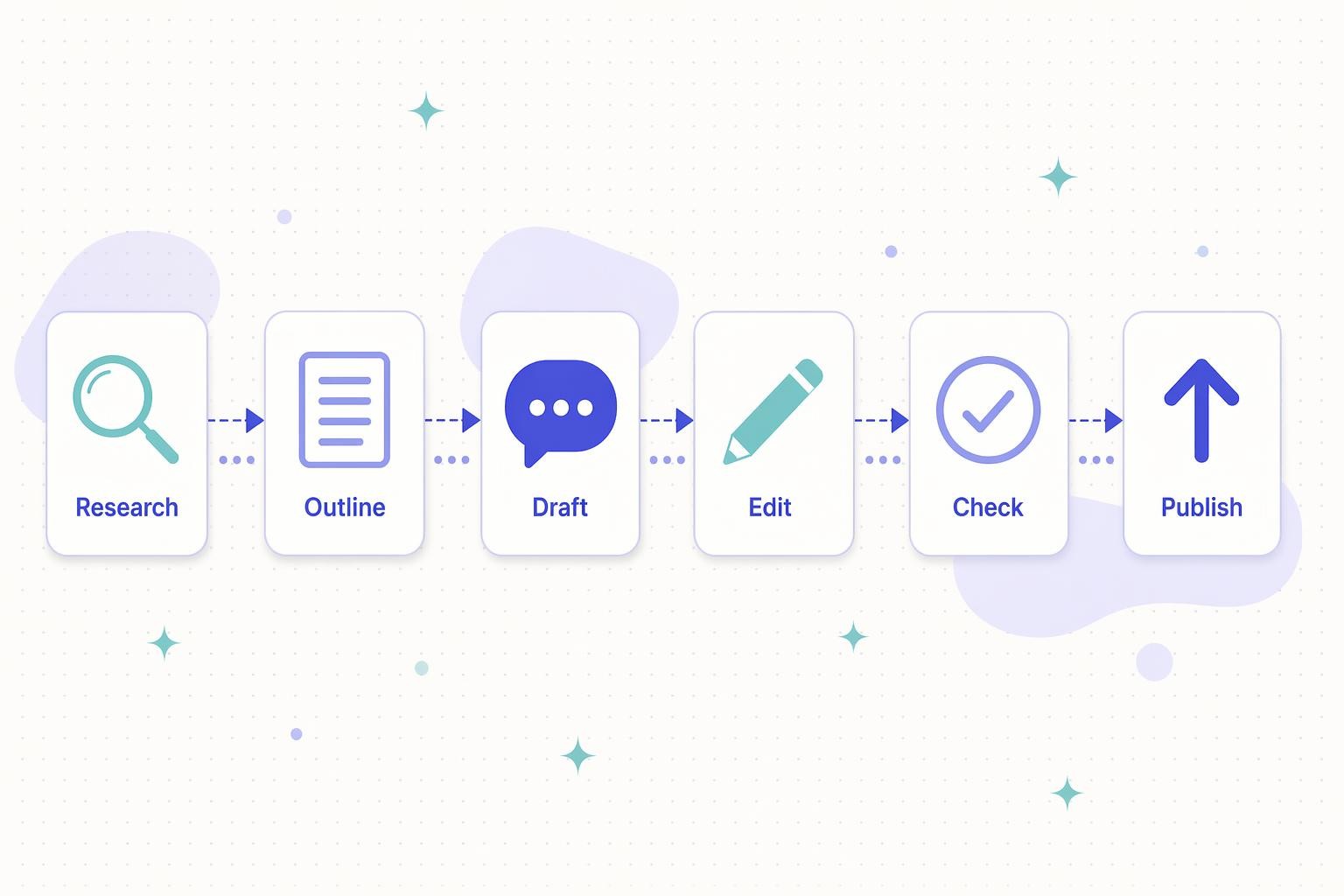
Six steps, in order.
1. Keyword and topic research
Start with real data from Ahrefs, Semrush, or Google Search Console. Dump the raw keyword list into ChatGPT and ask:
“Cluster these 200 keywords into related topic groups. For each group, identify the likely user intent (informational, navigational, transactional) and suggest one pillar-post topic that would cover the whole cluster.”
ChatGPT does this clustering well. It does NOT invent new keyword data. That comes from the tool, not the model.
2. SERP analysis
Look at the top 10 results for your target keyword manually. Then:
“Here are the headings from the top 5 ranking articles for [keyword]: [paste headings]. What subtopics is every article covering? What’s missing that a reader would want to know? What’s the average word count?”
Use the output as a starting structure, not a template. Content that copies existing SERP structure rarely outranks it.
3. Outlining
With your SERP analysis in hand:
“Write an outline for a blog post titled ‘[your title]’ targeting [specific audience]. Include H2s and H3s, a short intro that answers the query in the first 100 words, and a final summary section. Skip anything I should instead cover in a separate post.”
Review the outline. Cut 30% of what it suggests. Add what it missed from your own knowledge.
4. First draft
Feed the outline back in one section at a time:
“Write the [Section name] section of the outline above. Keep paragraphs under 3 sentences. Use plain language. No ‘game-changer,’ ‘unlock,’ ‘dive into,’ or ‘delve’ language. Don’t add filler transitions. First-person voice, matter-of-fact tone.”
The “no AI-trope language” instruction matters. Without it, ChatGPT defaults to marketing-speak that reads like AI output.
5. Heavy editing
This is the step most people skip. Every AI draft needs:
- A pass where you add genuine experience and specific details
- A pass where you cut fluff, hedging language, and repetition
- A pass where you verify every factual claim, statistic, or external reference
- A pass where you strip AI tropes (“delve,” “it’s not just X, it’s Y,” bold-first bullets)
- A read-aloud check (AI drafts sound different out loud)
If your post reads like ChatGPT wrote it, Google and AI engines will treat it that way.
6. Pre-publish optimization
Final pass with ChatGPT as a quality checker, not an author:
“Review this draft for: keyword density on [primary keyword], heading hierarchy (one H1, logical H2/H3 nesting), missing internal link opportunities to [list topic-related pages], and any claims that need citations.”
Acts as a second set of eyes without being the primary author. See my full formatting checklist for a human-review pass that pairs with this.
Prompt templates I reuse
For outlines
“Outline a [word count] blog post titled ‘[title]’ for [audience]. Include the answer to the main query in the first 100 words. Use H2s for major sections and H3s for subsections. Each H2 should have 100-200 words of content beneath it.”
For meta descriptions
“Write 10 meta description variations for the post titled ‘[title]’. Each under 155 characters. Include the primary keyword ‘[keyword]’ naturally. Prioritize clarity over cleverness. Avoid ‘learn more,’ ‘find out,’ and ‘discover.’”
For title variations
“Write 15 title variations for a post about [topic]. Each under 60 characters. Prioritize: direct benefit, primary keyword near the front, no ‘ultimate,’ ‘complete,’ or ‘unleash.’ Mix formats: how-to, listicle, question, ‘vs’ comparison.”
For rewriting awkward passages
“Rewrite this paragraph to be clearer and more direct. Keep my voice. Short sentences. No marketing language.”
For fact-checking flags
“Review this draft. Flag any specific claims, statistics, or dates that should be cited with a source. Don’t rewrite, just list them with line numbers.”
Using ChatGPT for GEO (getting cited by AI engines)
A 2026-specific use case: optimizing content to be cited BY ChatGPT (and Perplexity, Gemini, Google AI Overviews). The workflow:
- Ask ChatGPT your target query directly: “What is the best way to [your topic]?”
- Note which sources it cites and the phrasing of its answer
- Write your post to match that phrasing pattern and include the facts those citations contain
- Re-test monthly to see if you’ve earned a citation
Goes deeper in how to get cited by LLMs.
Common mistakes to avoid
- Publishing the first draft without any editing
- Letting ChatGPT “add personal stories” (they read as fake)
- Trusting statistics ChatGPT produces without verification
- Using “write a 2,000-word blog post about X” as your entire prompt
- Not stripping default AI trope language (“delve,” “unlock,” “in conclusion,” “it’s not just X, it’s Y”)
- Pushing volume over quality (10 mediocre posts a week doesn’t beat 2 great posts)
- Skipping keyword research and asking ChatGPT what keywords to target (it will confidently make them up)
Tools that help the AI-assisted workflow
ChatGPT alone is a general-purpose tool. For SEO-specific workflows, specialized tools save meaningful time:
- RightBlogger: content research, outlining, and drafting tools built specifically for bloggers. I built this to handle the full workflow above without copy-pasting between 5 tabs
- Rank Math’s Content AI: integrates SEO analysis with AI-assisted writing inside the WP editor
- Surfer SEO: pairs SERP analysis with on-page optimization suggestions
- Frase and MarketMuse: deeper competitor content analysis
- Claude and Gemini alongside ChatGPT. Each has different strengths. I use Claude for longer drafts and heavy editing, ChatGPT for quick tasks and brainstorming
The short version
In 2026, ChatGPT is a great SEO assistant and a terrible SEO author. Use it for clustering keywords, outlining, drafting first passes, and generating options. Do the editing, the fact-checking, the experience-adding, and the trope-stripping yourself. Content that reads “written by ChatGPT” gets penalized. Content that reads “written by a human who used ChatGPT well” still ranks.

Leave a Reply