
A content gap is any topic, keyword, format, or answer your audience wants that your blog doesn’t cover. Every gap is a competitor ranking in your place, a missed AI citation, and a reader bouncing to someone else’s site.
This post covers what content gaps actually are in 2026, the four types that matter (including a new one specific to AI search), how to find each kind, and how to prioritize which gaps to fill first.
What a content gap is (and what it isn’t)
A content gap is specifically something users are looking for that you don’t have. It’s not just “a topic you haven’t written about yet.” If nobody’s searching for it and nobody’s citing it, missing coverage isn’t really a gap. It’s just absent content.
That distinction matters, because filling a fake gap is just busywork. If you are short on genuine topics rather than validated ones, start with content ideation instead.
A true gap has three signals:
- Real user demand (search volume, Reddit threads, customer questions)
- Relevance to your topical authority (a fitness blog doesn’t have a “cooking” gap)
- Visible to at least one other player (competitor ranks for it, AI engines answer it, or users ask about it unprompted)
If all three signals are absent, you don’t have a gap. You have a non-market.
The 4 types of content gaps
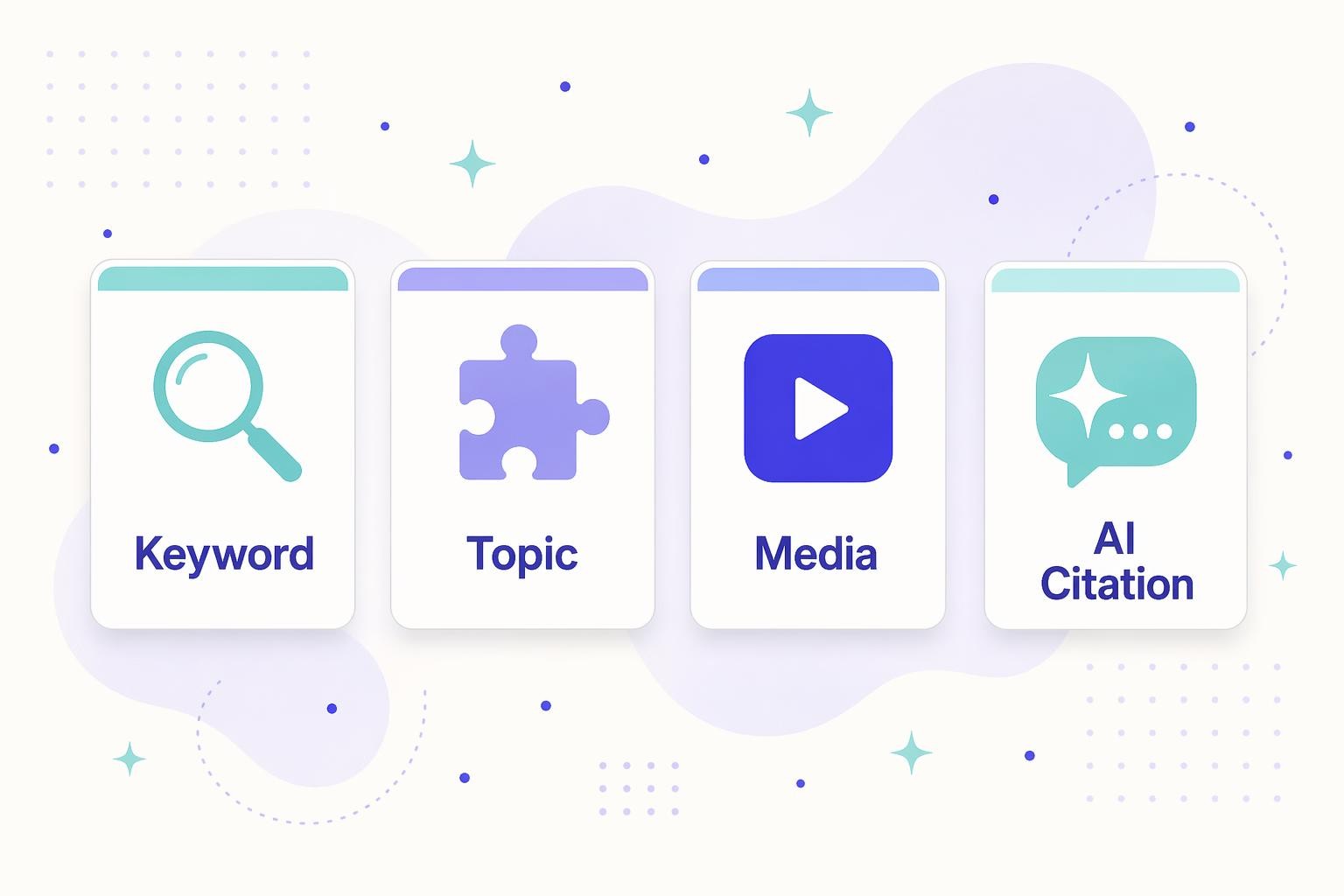
1. Keyword gaps
Specific queries people search for that you don’t rank for. This is the most measurable type and the easiest to find.
Example: a WordPress blog ranks for “best WordPress theme” but not “fastest WordPress theme for Elementor” even though that’s a high-intent long-tail query.
2. Topic gaps
Entire subtopics in your niche that you haven’t addressed, often spanning multiple related keywords at once.
Example: a theme blog covers theme speed and theme SEO but has zero content on block themes, Full Site Editing, or schema markup. Not one missing keyword. A missing topic cluster.
3. Media gaps
You cover the topic but in the wrong format for what the audience wants.
Example: your “how to install a WordPress theme” post is a 2,000-word text walkthrough, but the SERP favors short videos or GIF screenshots. Competitors ranking higher use video. You have a media gap on that specific page.
4. AI citation gaps (new in 2026)
Specific questions AI engines (ChatGPT Search, Perplexity, Gemini, Google AI Overviews) answer using other sources when they could be citing you.
Example: ChatGPT answers “what are the fastest WordPress themes” by citing 3 competitor blogs but not yours, even though your site has a theme-speed post. Your post either doesn’t answer the query directly enough, lacks the factual hooks AI engines grab, or isn’t structured for citation. I cover this in detail in how to get cited by LLMs.
Why content gaps cost you traffic
- Direct traffic loss: every keyword gap is traffic going to a competitor instead of you
- Topical authority erosion: Google ranks sites better when they cover a topic comprehensively. Partial coverage signals partial expertise
- AI engine invisibility: LLMs cite the source that most directly answers the query. A gap means someone else gets the citation for a topic you should own
- Lost internal linking leverage: fewer related posts means weaker internal link graph and less authority flow
How to find keyword gaps
Three workflows, in order of ROI:
Ahrefs Content Gap tool
- Open Ahrefs Site Explorer → enter your domain
- Click “Content Gap” in the left sidebar
- Enter 2-5 competitor domains in the “Show keywords that the below targets rank for” field
- Set “But the following doesn’t rank for” to your domain
- Export the list, filter for keywords with real volume (100+ searches/month) and manageable difficulty
Semrush has an equivalent tool under Keyword Gap. Same workflow.
Google Search Console opportunity keywords
The free way, for keywords you’re almost ranking for:
- Search Console → Performance → Queries
- Filter to position 8-20 (page 1-2 but not top)
- Sort by impressions descending
- These are queries you already rank for but could dominate with a dedicated, better-optimized page
Answer-engine query expansion
Use Google’s “People Also Ask” boxes, AnswerThePublic, and AI engines themselves. Ask ChatGPT or Perplexity your main topic question, then note every related question it generates. Each one is a potential keyword gap.
How to find topic gaps
Topic gaps are bigger than keyword gaps. To find them:
- Build a topic map of everything in your niche (pillars, subtopics, adjacent clusters)
- Check each node against your existing content. Empty nodes are topic gaps
- Look at top 3-5 competitors’ blog categories. Categories they have that you don’t are potential topic gaps
- Scan Reddit and Quora for recurring questions in your space. Entire question categories that repeat are topic gaps
Not every topic gap is worth filling. A fitness blog doesn’t need cooking coverage just because competitors have it. Stay on-wedge.
How to find media gaps
- For each of your top 20 posts, check the SERP for the target keyword
- Note what formats are ranking (video, interactive tools, infographics, image carousels, long text)
- If video thumbnails dominate but your post is pure text, you have a media gap on that page
- If interactive tools (calculators, converters) appear in organic results, a text post won’t compete at the top
Media gaps are easier to fix than topic gaps. Add a companion YouTube video, embed it in the post, or build a simple interactive element. Don’t rebuild from scratch.
How to find AI citation gaps
The 2026-specific audit. Workflow:
- Pick your top 10 most important topics
- Ask each one to ChatGPT Search, Perplexity, and Gemini as a direct question (“what is the fastest WordPress theme in 2026”)
- Note which sources are cited in each answer
- If you’re not cited, that’s an AI citation gap
- Analyze what the cited sources have that you don’t (direct answer in opening, factual claims, stats, author credentials)
Fix the page structure so AI engines can extract your answer cleanly. See how to get cited by LLMs.
How to run a competitor content analysis
Gap tools tell you which keywords a competitor ranks for that you do not. They do not tell you why that page wins, which is the part you actually need before writing anything. For your two or three closest competitors, work through this once:
- Pull their top 20 pages by organic traffic. This is their real content strategy, regardless of what their blog homepage emphasizes.
- Sort those pages into topic clusters. Wherever they have five posts and you have one, they have depth you do not.
- Open their three best pages and note format, not just topic: length, whether there is original data, a tool, a video, or a template.
- Check publish and update dates. A page refreshed last month against your three-year-old version is a freshness gap, not a content gap.
- Look at who links to those pages. If the links all point at one original statistic, the stat is the asset and the article is the wrapper.
What you are looking for is the pattern behind the wins, not a list of titles to copy. If a competitor’s best pages all include a calculator or a downloadable template, matching their word count will not close that gap.
One caution: competitors are a starting point, not a target. Copying their coverage exactly leaves you permanently second, because you are always writing the version that already exists. Use this to find where the demand is, then win by covering it better or differently. Our guide on running a content audit covers the other half of the picture, which is fixing what you already have.
How to prioritize which gaps to fill
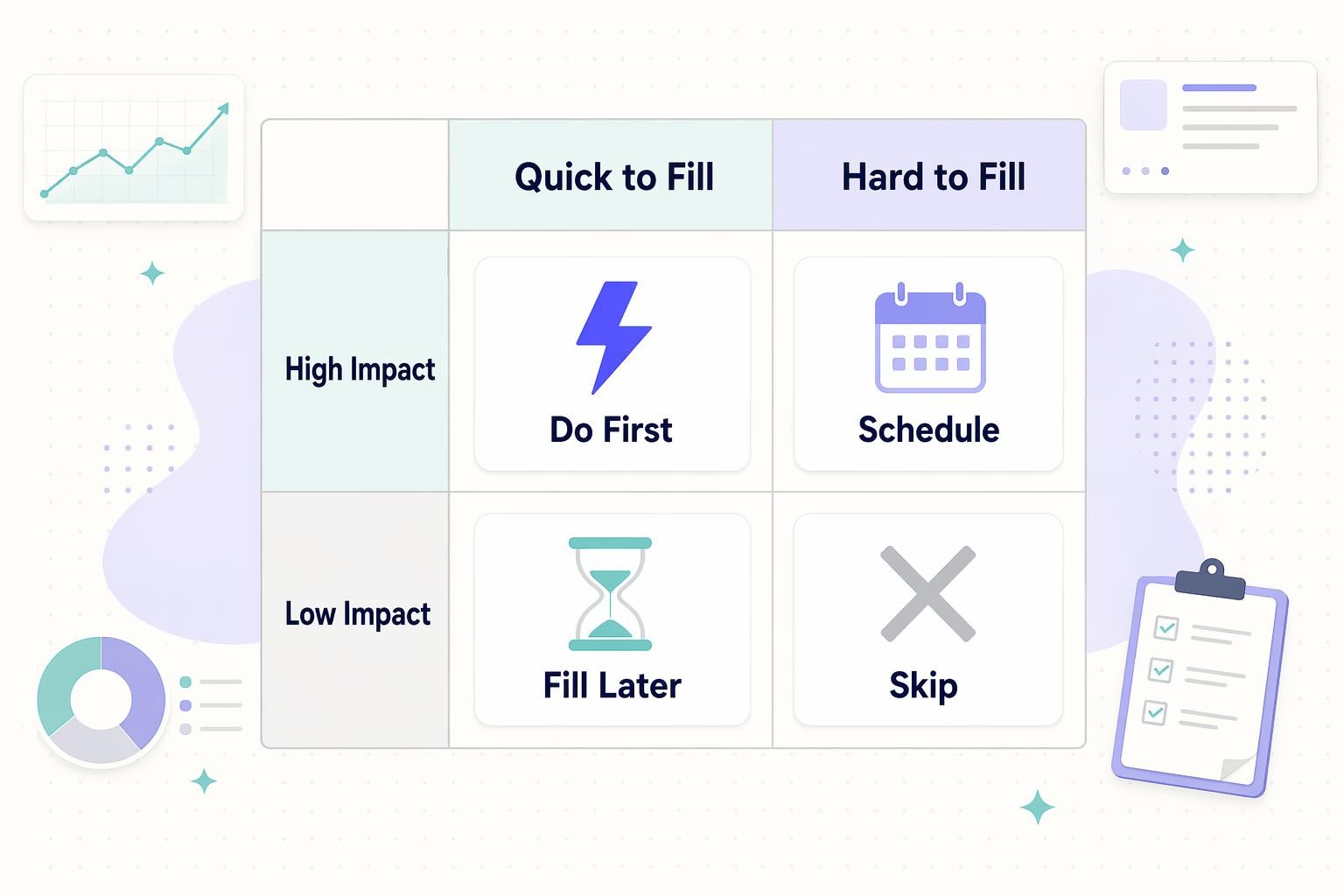
You’ll find more gaps than you can fill. Use a 2×2 to decide what to tackle first: impact vs. effort.
- High impact + quick to fill: do these first. Usually keyword gaps where you have similar content and just need a dedicated page, or media gaps fixable with a 2-minute video embed
- High impact + hard to fill: schedule. Entire topic clusters or custom interactive tools worth the investment
- Low impact + quick to fill: fill later as filler between priorities
- Low impact + hard to fill: skip. Not every gap deserves to be closed
Tools worth using
- Keyword gaps: Ahrefs Content Gap, Semrush Keyword Gap, Google Search Console (free)
- Topic gaps: Semrush Topic Research, AnswerThePublic, Reddit search, RightBlogger’s Content Gap tool
- Media gaps: manual SERP inspection, Ahrefs’ SERP overview
- AI citation gaps: direct queries to ChatGPT Search, Perplexity, Gemini; emerging tools like Profound or Otterly.ai for tracking
- Keyword research cross-reference: Ryan Robinson’s free keyword tool for quick validation
What to do once you’ve filled a gap
- Submit the URL in Search Console (request indexing)
- Add internal links to the new post from 3-5 relevant existing pages
- Monitor the target keyword’s ranking weekly for the first month
- Re-run your AI citation check 30 days later to see if you’ve earned citations
- If you’re running full content audits too, feed the filled gap data back in (see content audit workflow)
The short version
A content gap is something users want that you don’t have. Four types: keyword, topic, media, and (new in 2026) AI citation. Find them with Ahrefs Content Gap, Search Console, SERP inspection, and direct AI queries. Prioritize by impact × effort. Fill the high-impact quick wins first. Skip the gaps nobody would care about.

Leave a Reply